Ministering in Word and Deed; in Peace and Conflict
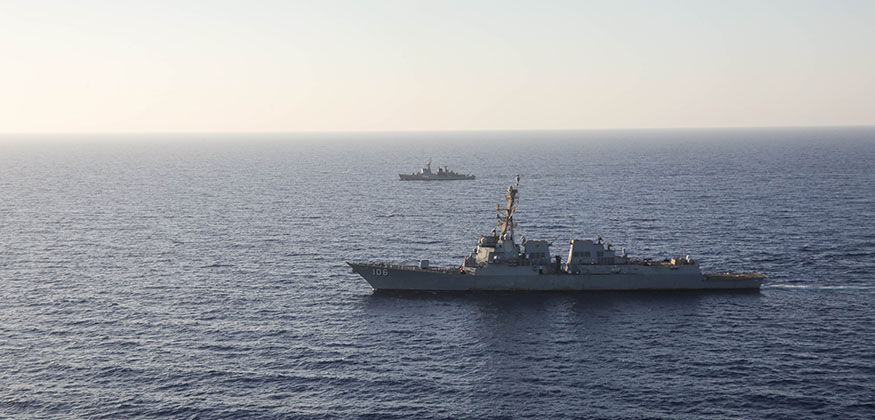
However, as 41-year-old Lt. Commander Chaplain Michael Johnson knows firsthand, with lethal strike capabilities, maneuverability, and superior defense armaments, Stockdale is a ship designed to be put in harm’s way; in times of war or any type of potential conflict where the Navy’s presence is needed, destroyers are nearly always a vital part of a deployment.
And if a ship is in harm’s way, its crew is in harm’s way and from July 2024 to February 2025, Stockdale spent an inordinate amount of time “serving in some of the most complex naval combat operations since World War II (Seapower Magazine).”
One would think that with ballistic missiles being launched toward you at speeds that can exceed 5,000 mph hour, it would give cause to seek out a chaplain at first opportunity. However, Johnson, endorsed by AG U.S. Missions Chaplaincy Ministries, says his work as a chaplain begins well before those potentially life-ending moments. Prior to deployment, Johnson spends weeks prepping the crew spiritually, emotionally, and mentally — for if Stockdale’s defenses should happen to fail during a ballistic missile attack, a few breaths may be all that many of the crew would have left.
“The Navy has two programs, Expanded Operation Stress Control and Warrior Toughness that I integrate with religious ministry,” says Johnson, a Navajo who graduated from American Indian College (now Nelson AIC) in Phoenix. “I led these life skills trainings every week, which helped contribute to resiliency and prep sailors for stress reaction.”
Over time, Johnson’s instruction struck home with officers and enlisted personnel, making for, as Johnson says, “a very successful experience as a ship when sailors encountered their first combat experience.”
YES, IN HARM’S WAY
Stockdale was deployed in July 2024 for seven months to the U.S. 3rd, 5th, and 7th Fleet areas of operations. In August, Stockdale was a part of USS Abraham Lincoln Carrier Strike Group.
According to Seapower Magazine, during its deployment with the 5th Fleet, Stockdale “successfully repelled multiple Iranian-backed Houthi attacks during transits of the Bab el-Mandeb strait and escort operations of U.S.-flagged [merchant] vessels in the Gulf of Aden. During these engagements, Stockdale successfully engaged and defeated one-way attack uncrewed aerial systems (UAS), anti-ship ballistic missiles, and anti-ship cruise missiles.”
In one conflict in November, USNI News reported that Vice Admiral Brad Cooper was aboard Stockdale and how Cooper shared that Stockdale had to use its five-inch guns to take out a Houthi drone that was a late detection. In the same attack, Stockdale fired an SM-6 (a multi-mission missile) to take out a Houthi missile.
“When you just think about this, it’s a bullet hitting a bullet. It’s about 5,000 mile-an-hour closure speed on this,” Cooper stated in the article.
Johnson says that in combat situations like they experienced in the Red Sea region, there’s a lot of excitement and adrenaline — along with fatigue and boredom.
“It’s hard to compare to other things,” Johnson says. “Following those times of super-high excitement, lethality, and potential death there comes boredom, even depression. Through our pre-deployment preparation as well as onboard, I help sailors through combat counseling — helping them understand the emotions and thoughts they’re encountering.”
PRESENCE
In a disaster or tragedy, simply the presence of chaplain or minister can bring a sense of assurance as it subtly reenforces the fact that God is aware and He is present.
In the Navy, when deployed in any situation, even a seemingly routine deployment can turn unexpectedly deadly in a moment’s notice. So, the ongoing presence of the chaplain brings reassurance to the crew.
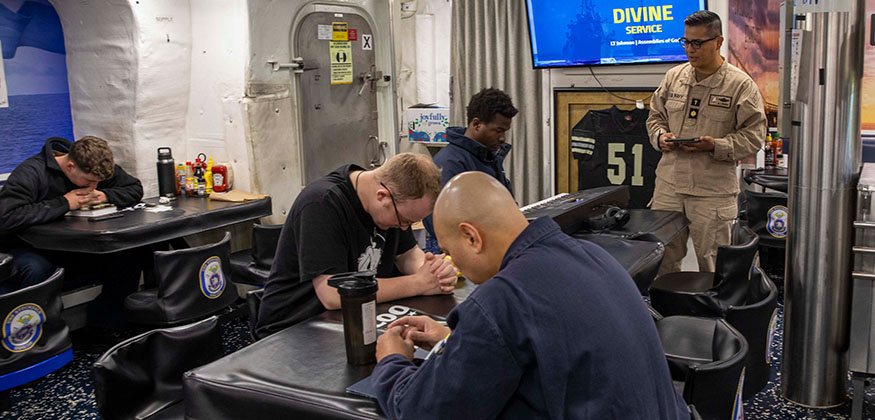
“In the chaplaincy, we call it ‘Deck-Plate’ ministry,” Johnson says. “Wherever the sailors are on deck, we are there, on the scene, engaging with them, walking around, showcasing a sense of strength, comfort, and availability . . . the chaplain is a symbol of hope, so there’s a sense of comfort among the crew when the chaplain is nearby.”
And in the combat situation such as experienced in the Red Sea by Stockdale’s crew, Johnson says that it’s not unusual for sailors, especially those experiencing their first combat (though far from limited to them), to have a much stronger sense of their vulnerability.
“The shortness of life and their lives flash before their eyes in this type of combat,” Johnson explains, estimating the average sailor’s age is around 25. “The type of engagements we were involved in weren’t bullets; we’re talking missiles meant to wipe out a ship. Sailors are aware of our capabilities as well as their enemies’ capabilities.”
“For the majority of my career at sea, destroyers have not had their own chaplain,” states Commander (CDR) Jacob T. Beckelhymer, Johnson’s commanding officer. “Michael is the first permanently assigned to Stockdale and he came at the perfect time. The more resources we provide sailors to improve resiliency and manage stress the more effective we can be, in and out of combat."
Chaplain Jim Denley, the military and Veterans Affairs representative for Chaplaincy Ministries, explains, “While the military emphasizes qualities like resilience and toughness to build strong warriors, Chaplain Johnson’s role is to offer something much deeper — the ultimate hope and meaning found in a relationship with our Savior. Standing on the Solid Rock is what makes us incredibly resilient, and that strength beats in the hearts of Chaplain Johnson’s people because of his ministry.”
SELFCARE
While helping others walk through shared traumatic experiences that can take place in the military, Johnson says that he’s come to realize that like any minister or chaplain responding to a disaster or tragedy, selfcare is what enables him to continue to minister effectively.
“Just as an athlete has a regimen to stay in shape for his or her sport, I have developed a rhythm that allows me to continue to effectively serve as a chaplain,” Johnson says.
Johnson explains that he has a ministry fitness program — not original to him — that he believes every minister could benefit by emulating.
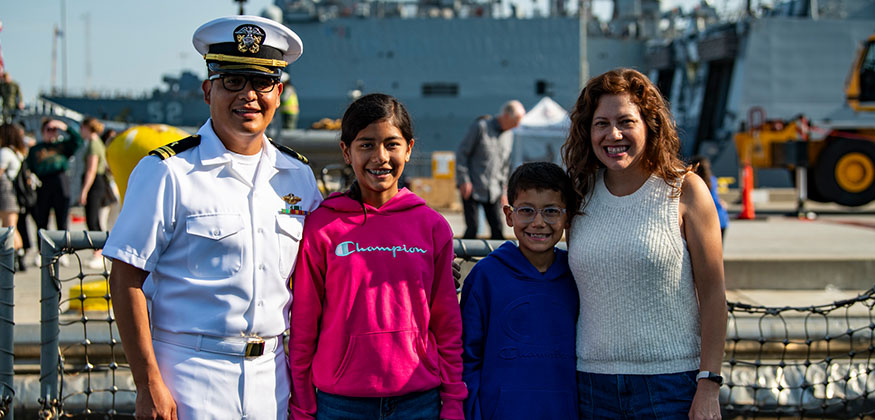
“My first priority is my faith — prayer, devotion, worship, fasting, and spiritual community I keep at the forefront — followed by my family,” Johson says. “Too many ministers fall into the trap of putting ministry above family . . . family is really critical, and I do things daily to nurture my family.”
Johnson says fitness comes next. He exercises on a daily basis, including cardio and weights.
“I love physical fitness — it's been a big part of my life,” Johnson states. “It has helped me to stay productive, focused, and helped me through life's challenges — it's like each workout session simulates the need to endure and overcome, to never quit."
Johnson also includes mental health as an important part of total fitness, stating he intentionally seeks out help as needed, noting that mental health issues have become an epidemic among ministers.
Johnson’s fourth priority is his work, which he really enjoys. However, he also invests in his profession through reading, taking courses, and being open to mentorship in order to be at his best for those he serves.
MILITARY PERSPECTIVE
Johnson says that for his and many military families, news media coverage of conflicts can be particularly devastating. In an attack, the media often shares what took place, such as a Houthi missile attack on military ships, well before military personnel are able or permitted to contact their families.
“It’s a huge ordeal,” Johnson says. “We’re not right there with our families, we can’t give context, we can’t explain anything, or comfort them . . . it’s heart wrenching for the crew and it’s a time of uncertainty and even fear for families, especially if unspecified casualties are reported.”
What’s more, many times families — depending on the deployment — don’t know where their family member’s ship has been deployed to. This results in the extended uncertainty of families — was their son/daughter/spouse in that region, on a ship that was attacked? They can only sit and wait until the military contacts them with information that often comes well after media reports.
“You can understand how sailors come to the chaplain, needing help, needing guidance, asking for prayer as there is often no contact permitted with family,” Johnson says. “It’s so difficult not being available to help your family, but it’s times like these that I trust God to give me ears to hear and the words to say that will mean the most to every individual crew member who approaches me — and in a sense, each interaction is a divine appointment.”